
Strong
It holds its shape.
A tough fiber network that resists tearing and puncture, the separator's first job in a cell.
Aramid nanofibers a few nanometers across, woven into an ultrathin separator. Same chemistry as the fiber behind body armor, with no melting point. More energy and more power from every cell, with safety built in.
Chemistry-agnostic · Li–S · NMC · LFP
In Greek myth, Arachne was a weaver so skilled she challenged the goddess Athena, and was turned into the first spider.
Spiders spin fine fibers into webs that are light, open and remarkably tough. Spider silk is often compared with Kevlar. ARACHNE starts from Kevlar's own chemistry, splits it into nanofibers and weaves them into a web that guards the inside of a battery.
Hover or tap an axis. Each strand of the web is one capability. Touch the strands and they vibrate.
The heart of your energy sits between the electrodes. ARACHNE aramid nanofiber separators are developed for cells like this 4EVR × Valerion pouch cell.
Move your cursor over the cell to turn it in the light and look inside through the lens.Tilt your phone to turn the cell in the light, and drag across it to look inside through the lens. Tap a marker to see what each part does.
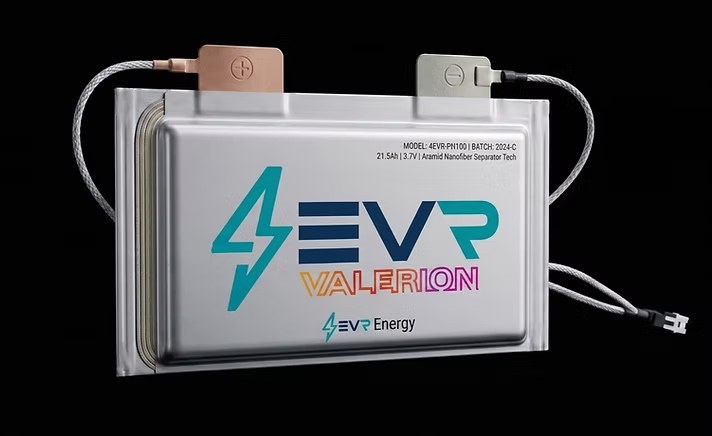
Hover or drag across the cell to see the stacked layers, or tap a marker.
Aramids are the polymer family behind protective fibers such as Kevlar. Split into nanofibers, the same chemistry becomes a thin, porous mesh that sits between a battery's electrodes.
A tough fiber network that resists tearing and puncture, the separator's first job in a cell.
Aramids char at very high temperature instead of melting, so the separator stays in place when a cell runs hot.
Nanofibers knit into an open, connected pore network that electrolyte fills and ions pass through.
The separator stores no energy. It is overhead that ions must cross. Thinner is better for energy and power, but every film loses mechanical protection as it gets thinner, and a polyolefin film melts at the same temperature however thin it is. Here is how each effect scales.
A cell is a stack of repeating units: cathode, separator, anode, separator. Every micrometer of separator adds height but no capacity, so a thinner separator packs more electrode into the same volume.
Ions cross the separator through electrolyte-filled pores. Its area resistance grows with thickness L and with the MacMullin number N, which captures how tortuous and porous the pores are. Halve L and you halve this resistance and the voltage it costs at high current.
Resistance to puncture by particles, burrs or dendrites scales roughly with thickness times the material's strength. Melting does not depend on thickness at all: polyethylene melts near 130 °C whether it is thick or thin.
–
–
Stiff aramid chains, hydrogen-bonded into nanofibers and tangled into a continuous web, spread a load across countless fiber contacts. A stronger material can be made thinner and still resist puncture.
Aramid does not melt and the web barely shrinks when hot. A thin layer keeps covering the electrodes right to the edges in temperature ranges where polyolefin films melt and pull back.
Small, interconnected pores that wet readily with electrolyte keep the MacMullin number low, so thinness turns into lower resistance. Evenly spread ion flow also helps lithium plate smoothly instead of growing dendrites.
4EVR Energy Tech pioneers advanced nanocomposite engineering for next-generation energy storage. ARACHNE is our breakthrough platform, built for high safety, strong performance and scalable reliability.
Our proprietary ARACHNE separator technologies enhance energy density, thermal stability and safety across EV and defense applications, bridging materials science with scalable manufacturing.
From lab-scale nanomaterials to pilot-scale production, built to scale with the cell makers we work with.
Conventional polyolefin separators are stretched films with elongated, slit-shaped pores. ARACHNE is a continuous network of aramid nanofibers. Drag across the figure to compare.
A scanning electron micrograph of an aramid nanofiber network. A single aramid nanofiber is only a few to a few tens of nanometers thick, so the bright strands here are mostly bundles of them; the dark spaces between are the pores that fill with electrolyte. Move the loupe across it to look closer.
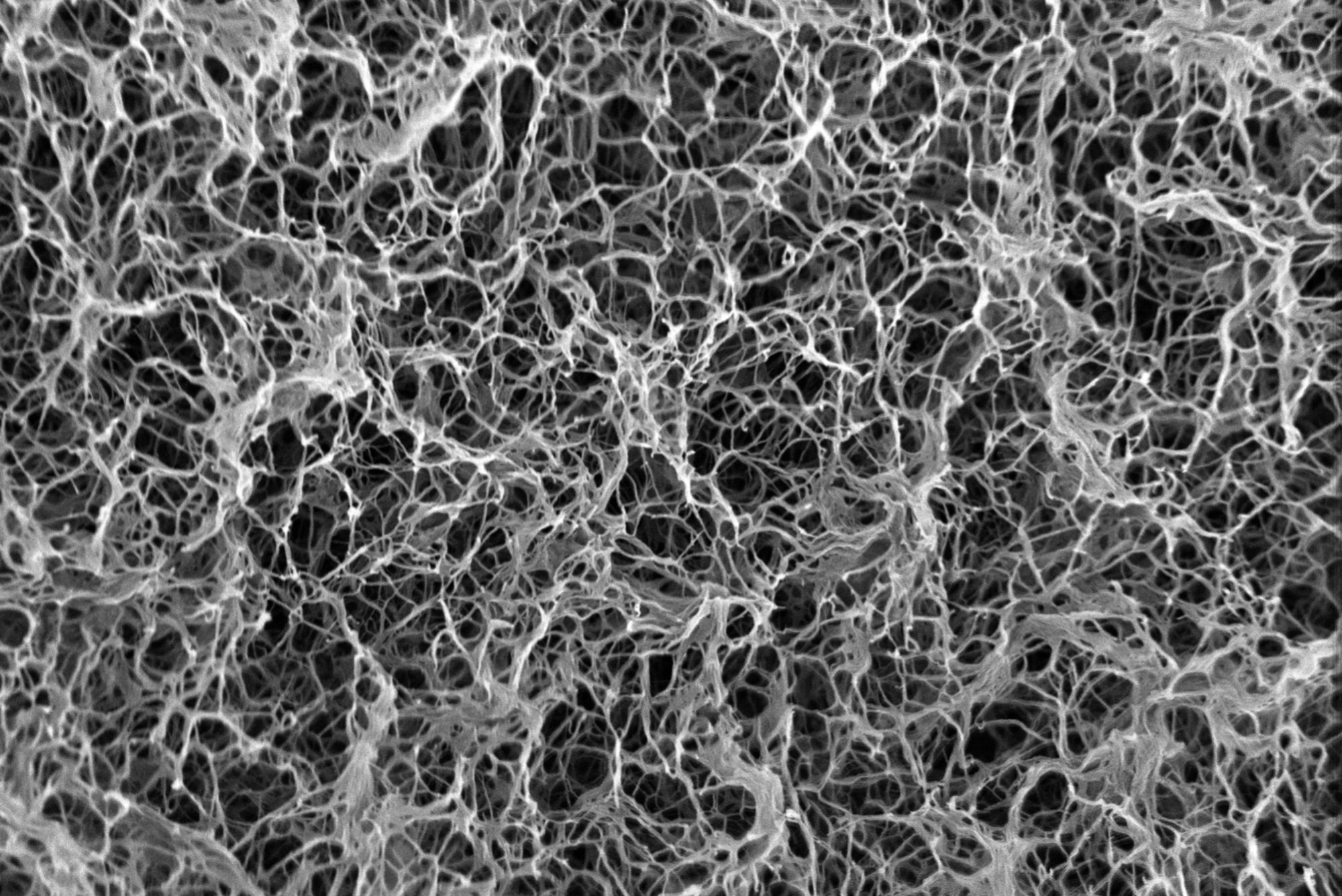
Both are made of the same aramid polymer, poly(para-phenylene terephthalamide). The chains are stiff, lie side by side and are tied together by hydrogen bonds, which is where the strength and heat resistance come from. The difference is scale and shape. A Kevlar fiber is a thick, solid thread. Aramid nanofibers are what you get when that thread is gently split apart into strands about a thousand times thinner. Those strands can then be cast into a thin, continuous, porous web.
Drag the slider to split the fiber.
Kevlar® is a registered trademark of DuPont. It is named here only to describe the material class.
A battery packs a lot of energy into a small space, right next to a flammable liquid. If the electrodes ever touch inside a cell, the energy can release as heat instead of electricity.
That heat can trigger a self-feeding chain called thermal runaway, and in a pack it can spread from one cell to the next. In electric vehicles, homes, aircraft and grid storage, preventing that chain is not optional. Safety has to be built into every layer, and the separator is the last physical barrier between the electrodes.
High-nickel cathodes and lithium-metal anodes store more energy, so there is more to release if something goes wrong.
Fast charging creates heat and can plate lithium on the anode, the seed of dendrites.
Large EV and grid packs hold hundreds or thousands of cells, so one failure must not spread.
Drag the temperature up and watch what happens inside a typical lithium-ion cell.
Temperatures are approximate and depend on chemistry, state of charge and cell design. A separator cannot stop every reaction, but one that stays in place keeps the electrodes apart for longer and removes a key trigger.
See dendrites in the Lab →Polyolefin separators soften and shrink as they approach their melting point, which can let the electrodes touch at the edges. Aramid has no melting point, so the separator keeps the electrodes apart. Drag the slider to heat both cells.
Eight small tools for students, engineers and the curious. Numbers are textbook approximations for learning, not 4EVR product data.
Cell voltage is the gap between the two electrode potentials. Theoretical energy combines that voltage with how much charge each material can store per gram.
Every electron through the outside circuit is matched by one Li⁺ ion through the separator. Faraday's constant turns battery capacity into a count of atoms.
Q = capacity (Ah) × 3600 · n = Q / F · mLi = n × 6.94 g/mol · F = 96,485 C/mol
Device presets are cell-level capacity at about 3.7 V (e.g. 75 kWh ÷ 3.7 V ≈ 20,270 Ah).
Zn | Zn²⁺ ‖ Cu²⁺ | Cu has a standard voltage of 1.10 V. Change the ion concentrations and temperature and the Nernst equation moves it.
E = E° − (RT / nF) · ln([Zn²⁺] / [Cu²⁺]) · n = 2 · E° held at 1.10 V; activities taken as concentrations
Electrochemical impedance spectroscopy (EIS) applies a small AC signal from high to low frequency. This Randles circuit, Rs + (Cdl ∥ [Rct + W]), is the classic starting model. Move the sliders and watch the Nyquist plot.
Z = Rs + 1 / ( jωCdl + 1 / (Rct + ZW) ) · ZW = σW(1 − j)/√ω · 100 kHz → 10 mHz
Sandwich a soaked separator between two steel discs and Rs becomes its bulk resistance Rb. Then σ = L / (Rb · A).
Measure the bulk resistance Rb of a soaked separator (or a solid electrolyte pellet) between two blocking electrodes, usually the high-frequency intercept in EIS. Geometry turns it into conductivity.
σ = L / (Rb · A) · A = π(d/2)² · NM = σ₀ / σ · τ = NM · ε (tortuosity factor)
Swap graphite for lithium metal and the anode almost disappears, so every other layer starts to matter. Tune the stack, try a solid-state build, and watch stack-level energy respond.
Charging plates lithium onto the anode. Where ions arrive unevenly, lithium piles up into needle-like dendrites that reach for the other electrode. If one gets through, the cell shorts.
Ready.
Ready.
Separators that help packs carry more energy without giving up thermal stability.
Aramid chemistry for cells where a thermal event is not an option.
Chemistry-agnostic by design, with a focus on lithium–sulfur, NMC and LFP cells, and ready for lithium-metal chemistries that push separators harder.
ANF nanocomposites as a scaffold that reinforces solid and polymer electrolytes.
An open, continuous pore network that keeps ion pathways clear.
Stiff aramid layers for energy storage that also carries mechanical load.
We are shaping a higher standard for energy materials, combining deep science with engineering, built on discipline, sophistication and uncompromising intent.
Boğaziçi University Technopark, Kandilli, Üsküdar, Istanbul
info@4evr.energy